
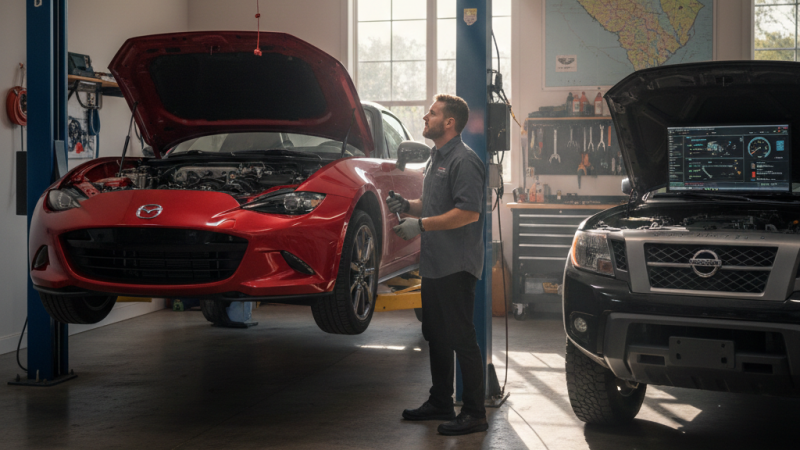
In an era of “software-defined vehicles,” touchscreens that control everything from the glovebox to the suspension, and engine bays packed tighter than a bento box, the DIY car enthusiast is facing a legitimate identity crisis. For years, the narrative has been that modern cars are “computers on wheels,” designed to be serviced only by dealership technicians with proprietary tablets.
But as we settle into 2026, a surprising trend is emerging: a handful of manufacturers are leaning back into mechanical accessibility, and a new generation of DIY tools is leveling the playing field.
The “New Golden Age” of Accessibility
While many luxury brands have moved toward “sealed” systems (some even removing the oil dipstick entirely), several mainstream models remain remarkably friendly to a set of jack stands and a socket wrench.
- The Naturally Aspirated Stalwarts: If you want a car you can service in your driveway, look for “NA” (naturally aspirated) engines. The Mazda CX-30 (2.0L) and Toyota Corolla remain favorites because they lack the complex plumbing of turbochargers, which often block access to spark plugs and sensors.
- The Spacious Engine Bay: The Nissan Frontier and Toyota Tacoma continue to offer something increasingly rare: room to breathe. These trucks are designed with high ground clearance (often allowing for oil changes without a jack) and engine bays that don’t require removing the front bumper just to change a headlight bulb.
- The Enthusiast Platforms: The Subaru BRZ and Mazda Miata are built specifically for people who turn their own wrenches. Their layouts are intuitive, and because they have massive aftermarket support, you can find a YouTube tutorial for literally every bolt on the car.
The DIYer’s New Toolbox
The “difficulty” of modern cars often isn’t mechanical—it’s digital. However, the DIY community has caught up:
- OBDII Scanners: In 2026, a $100 Bluetooth scanner paired with a phone app can perform many of the “dealer-only” resets, from electronic parking brake retractions to battery registration.
- Modular Design: More manufacturers are moving toward modular components. While individual parts can be expensive, the labor is often easier because entire assemblies are designed to be swapped out with a few clips and bolts.
The Reality Check: Software Locks
We have to be candid: the “Right to Repair” movement is still battling software locks. Some European brands now require a cloud-based subscription just to tell the car it has new brake pads. For the true DIY enthusiast, the most important “spec” to check before buying in 2026 isn’t horsepower—it’s whether the car’s ECU requires a proprietary handshake for basic maintenance.