
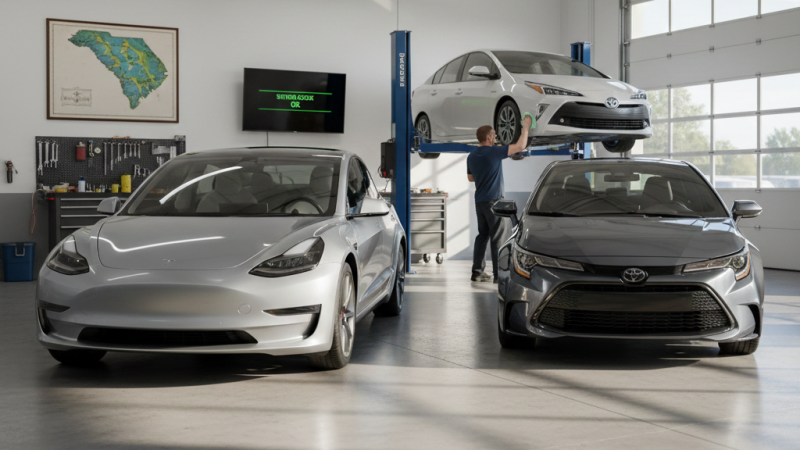
In the world of 2026 automotive data, the “maintenance-free” car remains a myth, but we have moved remarkably close to it. For the Lowcountry enthusiast who prioritizes time on the road over time on the lift, the post-2020 landscape has produced a few clear winners.
The “least maintained” vehicle isn’t just about how often it breaks; it’s about the sum of its scheduled services, the complexity of its powertrain, and the likelihood of major component failure over a 10-year horizon.
The Overall Champion: The Electric Fleet
It is a simple matter of physics: an internal combustion engine (ICE) has roughly 2,000 moving parts, while an electric motor has about 20. By removing the miniature explosions, exhaust systems, and multi-speed transmissions, EVs have effectively deleted the most expensive maintenance items.
- Tesla Model 3 / Model Y: Data from 2024–2026 consistently ranks these as the cheapest vehicles to maintain over a 5-year period (averaging roughly $1,100 to $1,400). Beyond tire rotations and cabin air filters, there is very little to do.
- Chevrolet Bolt EV: For those seeking a non-luxury entry, the Bolt remains a “sleeper” in reliability. Its thermal management system is robust, and it lacks the complex air suspensions or motorized door handles that plague higher-end EVs.
The ICE Icons: Toyota and Lexus
If you aren’t ready to go full-electric, the traditional “Kings of Reliability” still hold the crown. Toyota and Lexus dominate the long-term cost charts because their parts are plentiful and their engineering is conservative.
1. The Toyota Corolla (2020–Present)
The Corolla is the “Nokia of cars.” With an average annual maintenance cost of around $360–$400, it is the gold standard for the gasoline fleet. Its naturally aspirated engine avoids the heat-related stresses of turbochargers, and its CVT (Continuously Variable Transmission) has matured into a very dependable unit.
2. The Lexus ES 350
For the luxury-minded local, the Lexus ES 350 is essentially a refined Toyota Camry. It consistently ranks as the least expensive luxury car to own, with a 10-year maintenance estimate nearly $5,000 lower than its German competitors.
The Hybrid Middle Ground
Interestingly, 2025 data shows that Hybrids (like the Toyota Prius and Highlander Hybrid) are now arguably more reliable than pure gas cars.
- Regenerative Braking: Hybrids use the motor to slow down, meaning brake pads can easily last 100,000+ miles.
- Engine Longevity: The gasoline engine in a Prius works less hard than a standard engine, often staying in its “sweet spot” while the electric motor handles the heavy lifting of acceleration.
Summary Table: 10-Year Estimated Maintenance Costs (Lowcountry Estimates)
| Model | Powertrain | Estimated 10-Year Cost | Major Advantage |
| Tesla Model 3 | Electric | $3,500 – $4,200 | No oil, no exhaust, no spark plugs. |
| Toyota Corolla | Gas | $4,400 – $5,000 | Simple, non-turbocharged engine. |
| Toyota Prius | Hybrid | $4,100 – $4,800 | Exceptional brake life; proven tech. |
| Lexus ES 350 | Gas (V6) | $5,400 – $6,000 | Over-engineered “million-mile” V6. |
The Lowcountry Factor: In South Carolina, the “least maintained” car is often the one with the best factory rustproofing. While Tesla and Lexus lead in mechanical reliability, local enthusiasts still recommend secondary undercoating for any vehicle that spends its life near the salt air of Beaufort or Hilton Head.