
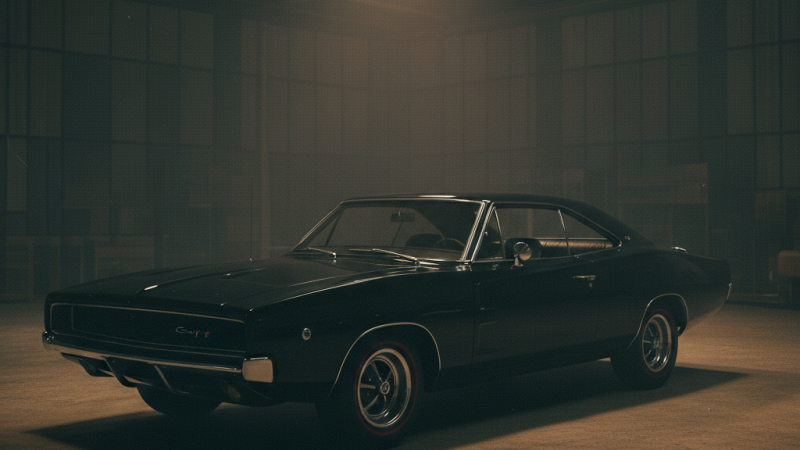
In the modern automotive landscape, cars are often designed by committee and refined by algorithms. But in the mid-20th century, the process was far more romantic. Designers didn’t have to worry about the cold mathematics of wind tunnels or the restrictive geometry of pedestrian impact sensors. They had a pencil, a block of clay, and a dream.
The Era of the Sculptor
This era of unbridled creative freedom birthed icons that transcend transportation to become high art. Take, for example, the Jaguar E-Type. With its impossibly long hood and flowing, organic lines, it was so striking that even Enzo Ferrari—a man not known for praising his competitors—famously called it “the most beautiful car ever made.”
Contrast that with the ’69 Dodge Charger. It doesn’t ask for your attention; it demands it. Its “Coke-bottle” styling and aggressive, muscular haunches represent an era where a car’s silhouette told a story of power and rebellion.
The “Rolling Egg” Syndrome
Today, most modern vehicles suffer from what enthusiasts call “the rolling egg” syndrome. To squeeze every possible mile out of a gallon of gas or a kilowatt of battery, manufacturers prioritize aerodynamic efficiency above all else. While this is great for the environment and your wallet, it has led to a homogenization of design. In a crowded parking lot, a modern crossover from one brand looks nearly identical to its neighbor from another.+1
Distinctions in Metal
Classic cars, by contrast, are fiercely distinct. The design language of the past was bold and unapologetic:
- The 1957 Chevy Bel Air: You can identify one from two blocks away just by the iconic, chrome-tipped curve of its tailfins.
- The Porsche 911: A silhouette so perfect it has remained largely unchanged for over half a century.
- The Lamborghini Miura: The car that defined the “supercar” look with its low-slung profile and “eyelashes” around the headlights.
These vehicles represent a time when cars were sculptures first and transportation second. They are timeless pieces of rolling history that turn heads and spark conversations in a way a modern, computer-optimized SUV never will. When you look at a classic, you aren’t just looking at a machine; you’re looking at the signature of the artist who drew it.