
In the modern era, opening the hood of a car feels like looking into the back of a supercomputer. You are greeted by vast plastic covers, a labyrinth of sensors, and miles of proprietary wiring. When a “Check Engine” light flickers onto your dashboard, it brings a unique brand of modern anxiety—the realization that you are likely powerless to fix it without a specialized diagnostic computer and a hefty dealership bill.
Classic cars, however, offer a different philosophy: the freedom of repairability.
The “Big Three” Philosophy
Most classic cars operate on a refreshingly simple logic often referred to as the “Big Three”: Air, Fuel, and Spark. If a vintage engine isn’t running, it’s almost certainly because one of these three elements is missing.
There is a profound mechanical transparency to these machines:
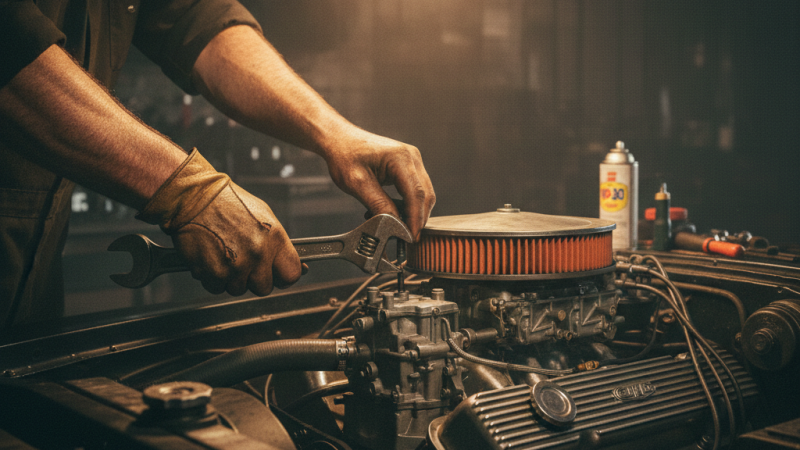
- Visibility: You can actually see the engine. There are no plastic shrouds hiding the mechanical heart of the vehicle.
- Accessibility: You can reach the spark plugs without removing the intake manifold. You can trace a fuel line with your bare hands.
- Tactility: You can tune a carburetor with nothing more than a simple screwdriver and a keen ear for the engine’s RPMs.
Master of the Hardware
This simplicity changes your relationship with the vehicle. In a modern car, you are a “user,” much like you are a user of a smartphone. You are restricted by software updates and “black box” components that are designed to be replaced, not repaired.
In a classic, you are the master of the hardware. When you fix a rough idle by adjusting a timing light or cleaning a distributor cap, you aren’t just performing maintenance; you are engaging in a dialogue with the machine. This creates an unbreakable bond between owner and car—a sense of self-reliance that is increasingly rare in our digital world.
The Saturday Morning Ritual
For the classic car enthusiast, the joy isn’t found strictly in the destination. It’s found in the Saturday morning ritual: the smell of degreaser in the garage, the weight of a heavy wrench in your hand, and the inevitable grease under the knuckles.
Keeping a piece of the past alive isn’t a chore; it’s a form of mechanical meditation. Every hour spent under the hood is an investment in understanding. When that engine finally roars back to life, it’s not just a machine working—it’s your work, humming a song of simple, sophisticated perfection.