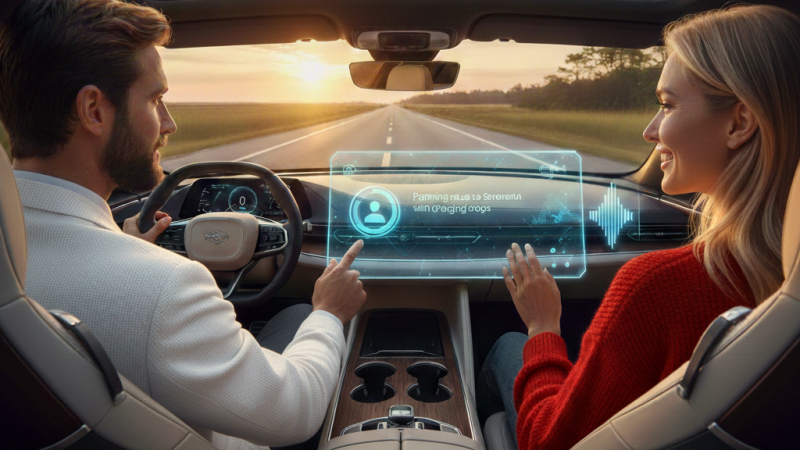
In 2026, the concept of automotive safety has moved light-years beyond airbags and crumple zones. While those passive systems remain crucial, the true revolution in protecting drivers, passengers, and even pedestrians lies in a suite of active, predictive technologies that act as unseen guardians, constantly monitoring, communicating, and intervening to prevent accidents before they ever occur. This year, the focus isn’t just on surviving a crash, but on making crashes a relic of the past.
The Car That Sees Around Corners: V2X Communication Goes Mainstream
Perhaps the most significant leap in driving safety for 2026 is the widespread adoption of Vehicle-to-Everything (V2X) communication. No longer limited by what its physical sensors can “see,” your car can now tap into a vast, live network of information. Imagine driving along a winding coastal road, and your vehicle receiving an alert that a sudden, heavy downpour has begun a mile ahead, creating slick conditions. Or, even more critically, your car can warn you of a stalled truck around a blind bend, relaying information from the truck itself, well before the obstruction comes into your line of sight.
This isn’t just about car-to-car communication; it’s about connecting to traffic lights, roadside units, and even pedestrian devices. If a child’s connected backpack or a cyclist’s smart device indicates they are about to enter a crosswalk obscured by parked cars, your vehicle receives that alert instantly, providing precious seconds to slow down or prepare to stop. V2X effectively grants your car a “sixth sense,” making it a truly proactive participant in the safety ecosystem.
AI That Understands Intent: The Evolution of Predictive Assistance
The AI systems powering our vehicles in 2026 are far more sophisticated than their predecessors. We’ve moved from simple “object detection” to “intent recognition.” This means the car’s artificial intelligence isn’t just identifying a ball rolling into the street; it’s inferring that a child might be following it. Using advanced vision-language-action (VLA) models, these systems can analyze subtle cues in the environment—a driver swerving in an adjacent lane, a pedestrian looking distracted by their phone—and predict potential hazards before they fully manifest.
This predictive assistance extends to driver monitoring as well. Advanced interior cameras and biometric sensors can detect early signs of driver fatigue, distraction, or even sudden medical emergencies. Instead of merely issuing a generic warning, these systems can actively intervene by gently nudging the steering wheel to keep the vehicle centered, initiating a safe pull-over procedure, or even connecting with emergency services if no driver response is detected.
The Intelligent Intervention: From Warnings to Automated Action
Modern safety systems are no longer just about beeping. They are capable of intelligent, nuanced intervention. Emergency braking systems are now incredibly precise, distinguishing between a false alarm and an imminent collision with remarkable accuracy. Lane-keeping assistance has evolved into sophisticated highway driving assist features that can handle complex merges and lane changes with minimal driver input, significantly reducing the risk of side-swipe collisions.
Furthermore, innovations like “Intersection Collision Avoidance” actively monitor cross-traffic when approaching an intersection, applying brakes or providing steering assistance if a potential T-bone collision is detected. Even backing out of a tight parking spot is safer, with “Rear Cross-Traffic Braking” that can automatically stop the vehicle if an unseen car or pedestrian is approaching.
In 2026, the car itself has become the most vigilant co-pilot, constantly scanning, analyzing, and communicating, working tirelessly to ensure that every journey is not just efficient and comfortable, but above all, safe.