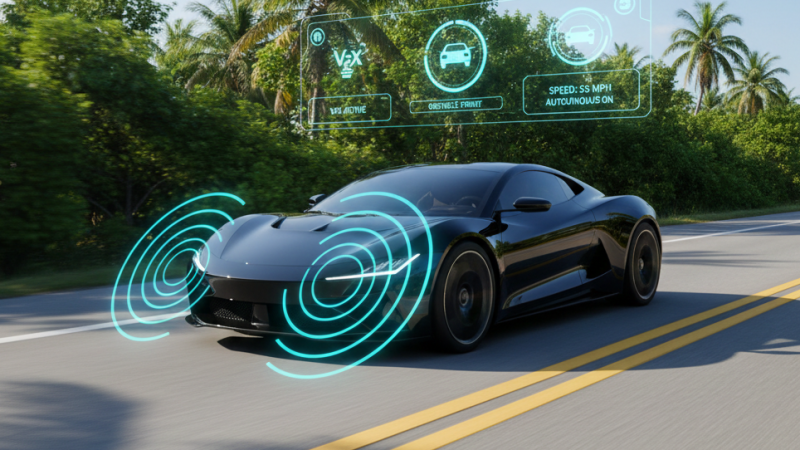
In 2026, the arrival of Vehicle-to-Everything (V2X) technology has provided drivers with a digital “sixth sense” that extends far beyond the physical reach of cameras and radar. While traditional sensors are limited by line-of-sight, V2X allows a vehicle to communicate directly with its environment through 5G and localized edge computing. This shift has turned the asphalt into a massive, live data network where every car, traffic light, and road sensor constantly shares vital information. For drivers in the Lowcountry, this means the car is no longer just reacting to what it sees in the next fifty feet, but to events happening miles away or around blind corners where oak trees and marshlands obscure the view.
The most immediate safety benefit of this technology is the ability to “see” through obstacles. If a vehicle three blocks ahead on a busy Savannah thoroughfare slams on its brakes to avoid a pedestrian, that data is instantly broadcasted to every trailing car via a Cooperative Awareness Message. Your dashboard can alert you to a hazard and even begin pre-charging your brakes before the car directly in front of you has even tapped its brake lights. This split-second advantage is the difference between a controlled stop and a multi-car pileup, effectively eliminating the chain-reaction accidents that have long plagued highway travel.
Beyond emergency safety, V2X has introduced a new level of efficiency through Green Light Optimization. In smart corridors now active in Atlanta and expanding into coastal South Carolina, traffic signals broadcast their timing data directly to your vehicle’s computer. Your car can then suggest a specific “gliding speed” that ensures you arrive at the next three intersections exactly as they turn green. By synchronizing the car’s momentum with the infrastructure, stop-and-go driving is being phased out in these zones. This not only makes the commute more relaxing but also significantly reduces the mechanical wear on brake pads and maximizes the regenerative efficiency of electric and hybrid batteries.
This connected ecosystem also protects the most vulnerable people on the road. Through Vehicle-to-Pedestrian (V2P) communication, smartphones and wearables can broadcast a person’s position to nearby vehicles even if they are hidden behind a parked truck or a building. When a cyclist enters a crosswalk at a blind intersection, the V2X system triggers an immediate warning to any approaching drivers. In 2026, the car has evolved from an isolated machine into a collaborative node in a broader safety web, proving that the most powerful safety feature isn’t just a stronger frame or more airbags, but the ability to talk to the world around it.
In 2026, the unique geography of the Lowcountry—with its winding two-lane roads, dense maritime forests, and frequent fog—makes V2X more than just a convenience; it is the ultimate safety co-pilot for coastal driving. On stretches like Highway 170 or the dark corridors of SC-46, the “sixth sense” of V2X can detect a stalled vehicle or a fallen tree limb hidden behind a sharp curve long before your headlights reach it. By communicating with local infrastructure, your car can receive real-time alerts about localized “king tide” flooding or sudden salt-mist visibility drops, adjusting its stability control and speed automatically to handle the slick, brackish conditions. Furthermore, in our wildlife-heavy region, V2X-equipped roadside sensors can broadcast “active crossing” alerts the moment a deer enters the roadway, providing a critical three-second warning that traditional radar might miss. This localized intelligence ensures that even when the marsh landscape obscures your view, your vehicle remains tethered to a digital map of the world that sees every hazard in high definition.