
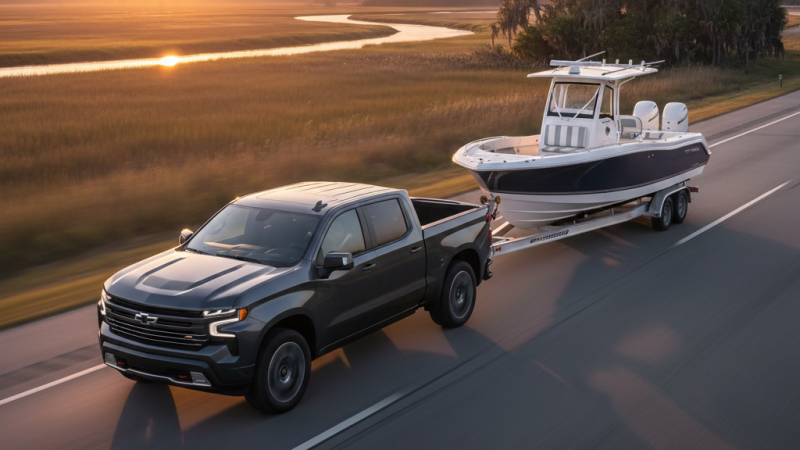
In 2026, the question is no longer whether an electric truck can tow, but rather how far it can go while doing it. The sheer physics of moving a multi-ton trailer hasn’t changed, but the technology inside the latest 2026 pickups has finally crossed the threshold from “novelty” to “workhorse.” For those in the Lowcountry hauling boats to the May River or trailers across the Broad River Bridge, the landscape of electric towing has fundamentally shifted.
The New Benchmarks of Power
The 2026 model year has seen a significant jump in raw capability. The Chevrolet Silverado EV and GMC Sierra EV have established a new standard, with top-tier trims now rated to tow up to 12,500 pounds. This is a critical figure, as it comfortably covers the majority of recreational boats and horse trailers used in the region. Close behind, the Rivian R1T and the Tesla Cybertruck continue to hold strong with an 11,000-pound capacity, while the Ford F-150 Lightning remains a versatile contender at 10,000 pounds.
What makes these trucks superior to their gas-powered predecessors in the moment of the pull is “instant torque.” An electric motor provides 100% of its pulling power the millisecond you touch the pedal. In 2026, trucks like the Sierra EV Denali deliver up to 785 lb-ft of torque, making the act of pulling a heavy load up a boat ramp feel effortless and, more importantly, remarkably quiet.
The Range Reality
The “elephant in the room” for electric towing has always been range, and 2026 offers a nuanced answer. It is now well-established that towing a heavy, non-aerodynamic load—like a tall travel trailer—will cut an EV’s range by approximately 50%. However, because 2026 battery packs have grown significantly, the “half-range” is finally becoming practical.
With the Silverado EV’s Max Range battery offering an unloaded EPA estimate of nearly 500 miles, local drivers are finding they can tow a 6,000-pound trailer for 230 to 250 miles on a single charge. For a trip from Bluffton to Charleston or Savannah, this means you can complete the journey without ever needing to unhitch and find a charger—a massive victory for real-world usability.
Aerodynamics and “Aero-Efficiency”
In 2026, savvy owners are learning that weight isn’t the primary range-killer; wind resistance is. Real-world testing has shown that towing a heavy but low-profile boat often results in better range than towing a lighter, boxy cargo trailer. To combat this, 2026 trucks feature advanced “Towing AI” that accounts for the trailer’s frontal area and real-time wind speeds to provide an incredibly accurate “distance-to-empty” reading.
Furthermore, the charging infrastructure has begun to adapt. Newer stations along major South Carolina corridors are finally being built with “Pull-Through” stalls, allowing truck owners to charge their vehicles without the tedious process of disconnecting their trailers first.
Intelligent Assistance
Towing in 2026 is also safer and more automated. Ford’s Pro Trailer Hitch Assist and GMC’s Super Cruise (which now supports hands-free driving even while trailering) have turned one of the most stressful parts of truck ownership into a series of automated tasks. From the truck automatically aligning its hitch ball with the trailer to the regenerative braking systems providing massive stopping power without overheating traditional brake pads, the 2026 electric truck has become the most sophisticated towing tool ever built.